
FOIL and Westchester County Public Records
New York opens most government files through the Freedom of Information Law, known as FOIL. The law lives in the Public Officers Law, Article 6. Section 87 sets the core rule. Agencies must make records open unless an exemption applies. This covers county departments such as Public Safety, the administrative side of the Department of Correction, and the non-court files held by the County Clerk. Anyone can file a FOIL request. You do not need to live here. You do not need to give a reason. The agency must respond within set time limits.
Court files work in a different way. New York courts say plainly that court records are not reached through ordinary FOIL. Access to court files is set by Judiciary Law § 255 instead. Under that rule, clerks must search files, papers, and dockets, then give copies when the record is open and the fee is paid. FOIL covers agencies. The Judiciary Law covers the courts. The County Clerk's own FOIL guidance draws the same line.
So one rule does not fit all. A police incident report follows FOIL. A felony case file follows the Judiciary Law. Both can be public, but you ask in different ways.
The County Clerk explains the FOIL split on its own request page.
The Westchester County Clerk FOIL page spells out when FOIL applies and when a court-record request is the right path.
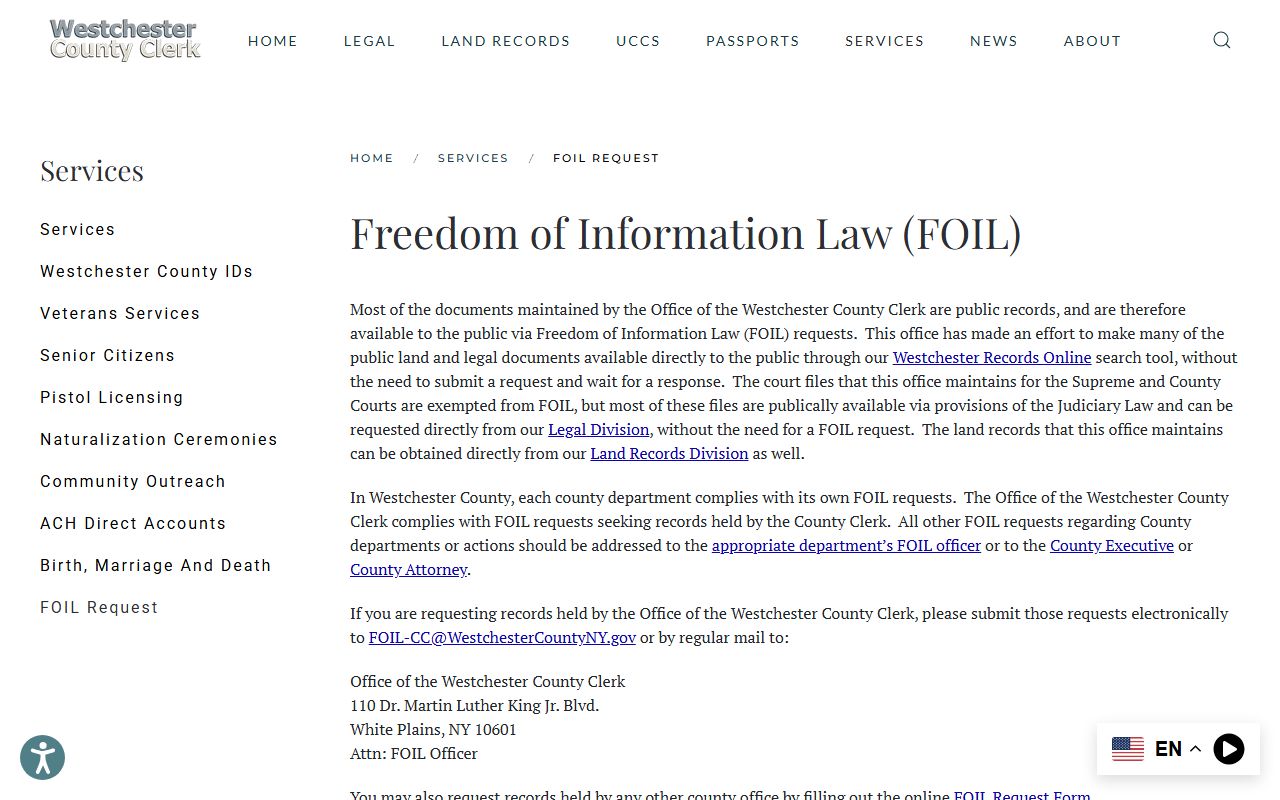
It points court-file requests to the Legal Division and keeps true FOIL requests on the agency track.
What the County Clerk Maintains
The Westchester County Clerk is the central record office for the county. It serves as Clerk for the Supreme and County Courts, so legal records for those courts are filed with its Legal Division. The Clerk also holds a long list of non-court records. These are the files most people mean when they search for Westchester County public records. Deeds, mortgages, business names, liens, and judgments all sit here. The office runs the Land Records Division, handles UCC filings, registers domestic partnerships, takes veterans' discharge papers, and issues notary and passport services.
The Clerk's Legal Division is the public counter for legal records, judgments, liens, lis pendens, and business filings. Staff can look up these records on site. Most legal records are open unless a statute or a judge seals them.
- Land records - deeds, mortgages, and maps, some going back to the 18th century.
- Judgments and liens - permanent public records, including money judgments, mechanic's liens, and notices of pendency.
- Business filings - DBA business certificates under General Business Law § 130 and UCC financing statements.
- Court legal records - Supreme and County Court files, judgments, and certificates of disposition.
- Other filings - domestic partnerships, veterans' discharge papers, and Small Claims Assessment Review petitions.
Many of these records can be searched online through Westchester Records Online, the Clerk's web portal. Searching is free. Viewing document images runs on a paid model.
Judgments and Liens in Westchester County Public Records
Judgments and liens are among the most requested Westchester County public records. The County Clerk treats them as permanent public records. An entry may show the original filing plus any later satisfaction or renewal. A money judgment tells you one party owes another a set sum. A lien is a legal claim against property. A notice of pendency, also called a lis pendens, warns that a lawsuit may affect a piece of real estate.
You can search these in person at the Legal Division in White Plains or online through Westchester Records Online. The portal pulls records that range from old deeds to judgments entered just last week. It groups searches into Land Records, Legal Records, Maps, and Trades. Searching the index costs nothing. Pulling the actual document image is where the fee comes in.
UCC liens have their own fee schedule, shown below. A UCC search runs per debtor name.
| UCC Service | Fee |
|---|---|
| UCC filing in paper (statement, amendment, assignment, termination, continuation) | $40 |
| UCC lien search | $25 per debtor |
| UCC certified copy | $10 per document |
| UCC uncertified copy | $5 per document |
Note: Civil case images on the portal go back to 1980 and criminal cases to 1978, but image viewing needs a paid subscription or a day pass.
Public Safety Reports and Agency Records
Police reports follow the FOIL track, not the court track. The Westchester County Department of Public Safety holds incident and accident reports for the matters it handles. You can get an incident report in person at county police headquarters during business hours. Bring a photo ID. The office charges small per-page and per-photo fees and uses a record inspection form, WCPD 82. An accident report has one extra step. You also fill out a Privacy Act Certification form before the report is released.
These reports are agency records, so FOIL governs them. The same goes for many administrative files held by other county departments. If a department denies a FOIL request, the law gives you a way to appeal, which the last section covers.
The county also lists which officials hold which records, a useful first stop when you are not sure where to ask.
The Westchester elected officials page names the County Clerk and District Attorney and links to the offices that hold key public records.
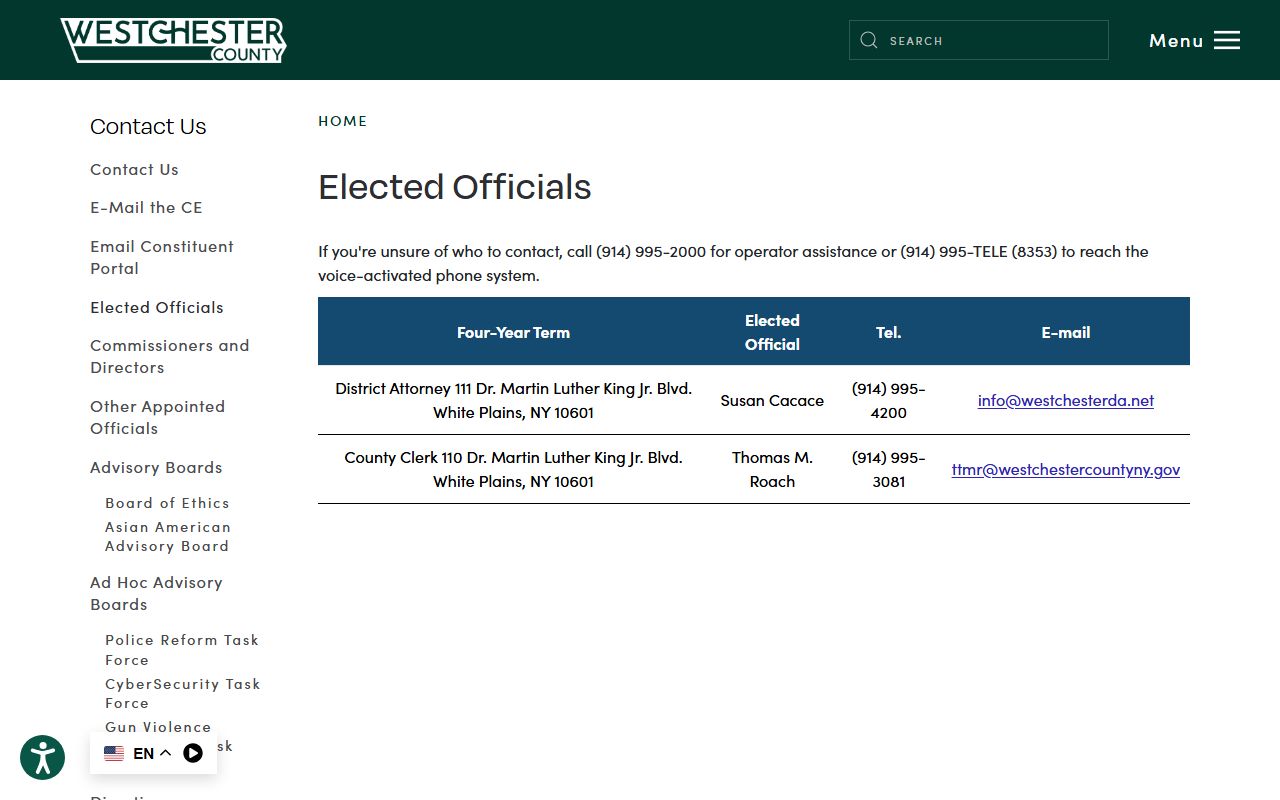
From there you can route a request to the right department instead of guessing at the front desk.
How to File a Public Records Request in Westchester County
The steps differ a little by record type, but the shape of the request is the same. First decide if you want an agency record or a court record. That single choice sets the law, the office, and the form. Then describe what you want as clearly as you can. A vague request slows everything down.
- Pick the right office. Court files and judgments go to the County Clerk Legal Division. Police reports go to Public Safety. Other files go to the county department that holds them.
- Decide the legal track. Agency files use FOIL. Court files use the Judiciary Law and a Legal Division request, not FOIL.
- Describe the records. Give names, an index or file number, a document type, and a date or date range where you can.
- Submit the request. File in person, by mail, or through the office's online tool. Public Safety reports are picked up in person with photo ID and form WCPD 82.
- Wait for the response. The agency must answer within the FOIL time limits, or the Clerk processes a court-record search.
- Pay the fee and collect the records. Mail requests to the Clerk include a check payable to "Westchester County Clerk." Cash is not accepted by mail.
For mailed Clerk requests, send a letter with as much detail as you can: index or file number, the document name such as a judgment, party names, and the filing date. Mail it to the Office of the Westchester County Clerk, Legal Division, Room 330, 110 Dr. Martin Luther King Jr. Blvd., White Plains, NY 10601.
Request Form Fields
Whether you use the Clerk's mail request or the Public Safety form WCPD 82, the office needs the same basic facts. The fields below mix what the County Clerk asks for on a legal record request and what Public Safety asks for on a report request. Filling each one in cuts back-and-forth and avoids the extra search fee.
| Field | Required | Notes |
|---|---|---|
| Requester Name | Yes | Your name and a return mailing address. |
| Photo ID | Yes (in person) | Public Safety report pickup needs a photo ID at headquarters. |
| Record Description | Yes | Document name such as judgment, deed, or incident report. |
| Index / File Number | No | If left blank, the Clerk adds a $10 search fee. |
| Party Names | Yes | Names on the case or filing; defendant name for a criminal disposition. |
| Filing Date | No | An exact date or rough range speeds the search. |
| Privacy Act Certification | Yes (accident reports) | Extra form required before an accident report is released. |
| Payment | Yes | Check to "Westchester County Clerk" by mail; small fees in person. |
Response Timelines
FOIL sets clear deadlines for agency records. The agency must respond within five business days. It can grant the request, deny it, or acknowledge it and give a date when it will answer. When more time is needed, that date must be reasonable based on the size and difficulty of the request. An agency cannot just sit on a request with no reply. Silence past the limits can be treated as a denial, which then opens the appeal route.
Court-record requests run on the Clerk's own processing time rather than the FOIL clock. In-office searches can be quick. Mail requests take longer. Older cases add the most time.
Documents filed before 2002 may need an off-site archive pull. The Clerk's public terminals show legal document images from 2002 to the present, so anything older is ordered from storage and given a delivery date. Plan for that gap when a case is decades old.
Westchester County Public Records Fees
Most fees for Westchester County public records are small. The County Clerk charges set amounts for searches and certified copies. The big exception is online image access through Westchester Records Online, which uses a subscription or a day-pass model. The table sums up the common charges.
| Item | Amount |
|---|---|
| Certificate of criminal disposition (certified) | $5.00 |
| Criminal disposition mail search, no indictment number | Added $5.00 |
| Legal record search with no index or file number | $10.00 |
| Each added legal record requested by mail | $5.00 each |
| Westchester Records Online search | No cost to search |
| WRO image access, one day | $20.00 |
| WRO image access, one year | $1,200 |
Note: A check for a mailed Clerk request must be payable to "Westchester County Clerk," and the office does not take cash by mail.
Records That Are Confidential
Not every record is open. Some categories are sealed by statute, others by court order. These limits apply whether you ask under FOIL or under the Judiciary Law. Matrimonial files are the clearest example on the court side. Domestic Relations Law § 235 keeps divorce, separation, and custody details closed to all but the parties and their attorneys. The County Clerk asks for proper photo ID and party or attorney status before it releases a divorce decree.
Criminal records have their own sealing rules. When a case ends in the accused person's favor, CPL § 160.50 seals it. Court entries, fingerprints, and photos all close. A separate law lets a person ask to seal certain old convictions.
Under CPL § 160.59, someone with no more than two eligible convictions, only one a felony, may apply after ten crime-free years. Serious and sex offenses are excluded. Family Court files, adoption records, juvenile delinquency files, and sex-offense victim identities are also restricted. The walkthrough below shows what a sealing applicant gathers first.
The state guide to conviction sealing covers who qualifies and how to apply.
The official CPL § 160.59 text sets the eligibility rules and the offenses left out.
An applicant first pulls a Certificate of Disposition for each conviction, then files the sealing motion and serves the District Attorney.
Sealed Criminal Files and Public Access
Sealing keeps a record out of public reach, but it works in stages and by different laws. A favorable termination seals by operation of law once the case ends in the defendant's favor. The applicant does nothing for that. Conviction sealing is the opposite. It needs an application, a court review, and notice to the District Attorney. A third path runs on its own.
New York's Clean Slate law adds automatic sealing for qualifying convictions after set waiting periods. Even then, certain law enforcement, licensing, and safety-sensitive users keep access.
The favorable-termination rule is the starting point for many sealed-record questions.
Read the official CPL § 160.50 text to see exactly which cases seal when charges end in the accused person's favor.
The statute lists the narrow exceptions where a sealed file may still be reached.
If Your Request Is Denied
A FOIL denial is not the end of the road. The law gives a built-in appeal. When an agency denies a request, or fails to answer within the time limits, you can file a written appeal with the agency's appeals officer. The agency must then respond within ten business days. It either releases the records or explains, in writing, why it still says no.
If the agency upholds the denial, the next step is the courts. You can bring an Article 78 proceeding in Supreme Court to challenge the decision. A judge then reviews whether the denial followed the law.
Court-record refusals work a bit differently, since those run under the Judiciary Law rather than FOIL. If the Clerk says a court file is sealed, ask which statute or order seals it. Parties and attorneys of record often have access the general public does not. For sealed files, you may need a court order. The court help centers can point you to the right motion.