
Why New York Calls It the Supreme Court
The name throws off most people from other states. In New York, the Supreme Court is the trial court of general jurisdiction. It is not the highest court in the state. That spot belongs to the New York Court of Appeals. So a case can start in the Westchester County Supreme Court and still be appealed twice above it. The setup feels backward, but it is how the state's Unified Court System works.
The Supreme Court in Westchester handles the biggest civil matters. It hears civil suits that run past the dollar limits of the lower courts. It takes divorce, separation, and annulment cases. It manages foreclosures, commercial disputes, tax certiorari, condemnation, medical malpractice, and environmental claims. These all sit above what County Court or a city court can hear.
County Court plays a different role outside New York City. In Westchester it conducts felony trials. It shares authority over misdemeanors and minor offenses with the city and town courts. County Court also has limited civil power, up to $25,000. Both courts run from the same White Plains building, and the County Clerk holds the records for each.
The Westchester County Supreme Court and the Ninth Judicial District
Westchester sits in the Ninth Judicial District. The district covers five counties. They are Dutchess, Orange, Putnam, Rockland, and Westchester. The Ninth Judicial District runs the trial courts across all five. That includes the Supreme and County Courts that meet in White Plains.
Appeals from Westchester trial courts follow a set path. They go first to the Appellate Division of the Supreme Court, Second Department. That is the intermediate appeals court for this region. From there, a case may reach the New York Court of Appeals, the state's highest court. Not every case gets that far. The Court of Appeals takes only some matters.
The official court overview is the best place to confirm where a case sits. It lists the courthouse address, the phone lines, the judges, and the calendars.
Check the NYCOURTS Westchester Supreme and County Court page before you start a search. It shows the civil office on the ninth floor and the criminal office on the second floor of the courthouse.
Westchester County Supreme Court and Local Court List
The Supreme and County Courts share one building in White Plains. The city courts sit in their own cities. The table below lists the main trial courts for Westchester, with the address, phone, and a short note for each. Use it to find the right office before you search or call.
| Court | Address | Phone | Notes |
|---|---|---|---|
| Westchester Supreme & County Court | 111 Dr. Martin Luther King Jr. Blvd., White Plains, NY 10601 | Civil 914-824-5300; Criminal 914-824-5400 | Civil 9th floor, criminal 2nd floor; hours 9 to 5. |
| Westchester Surrogate's Court | 111 Dr. Martin Luther King Jr. Blvd., 19th floor, White Plains, NY 10601 | 914-824-5656 | Estates and wills; Chief Clerk Eugene Yates. |
| Peekskill City Court | 2 Nelson Avenue, Peekskill, NY 10566 | 914-831-6480 | Payments taken to 4 p.m. |
| Mount Vernon City Court | 2 Roosevelt Square North, 2nd floor, Mount Vernon, NY 10550 | 914-831-6440 | Criminal 914-831-6420; Civil 914-831-6410. |
| New Rochelle City Court | 475 North Avenue, New Rochelle, NY 10801 | 914-358-8000 | Local civil, criminal, and traffic. |
| Rye City Court | 21 McCullough Place, Rye, NY 10580 | 914-831-6400 | Fax 914-831-6546. |
| White Plains City Court | 77 South Lexington Avenue, White Plains, NY 10601 | 914-824-5675 | Online payment for some fines and fees. |
| Yonkers City Court | 100 South Broadway, Yonkers, NY 10701 | 914-831-6450 | Civil 914-831-6920; Criminal 914-831-6930. |
The official NYCOURTS list of Westchester courts carries the full set, plus the Family Court sites. Town and Village Justice Courts are not in the table above, since each town and village runs its own.
Supreme Court vs County Court vs City/Justice Court
People mix up these courts all the time. Each one hears a different slice of cases, and each keeps its own records. The Supreme Court takes the largest civil matters and all divorce cases. County Court runs felony trials. City and Justice Courts deal with local, smaller, and lower-dollar matters. The table sums up the split for Westchester County.
| Supreme Court | County Court | City / Justice Court | |
|---|---|---|---|
| Civil Reach | No set ceiling | Up to $25,000 | Local, lower-dollar civil and small claims |
| Criminal Reach | Specialized civil parts; rare criminal | Felony trials, some misdemeanors | Misdemeanors, violations, traffic |
| Divorce | Yes | No | No |
| Where Records Sit | County Clerk | County Clerk | Each city or town court |
One point matters for searches. The County Clerk holds Supreme and County Court files. City and Justice Court files stay with each local court. So a divorce or foreclosure goes through the Westchester County Clerk, while a traffic ticket stays at the city court that took it.
How a Case Moves Through the System
Cases climb a clear ladder in New York. A minor matter may start low and stay low. A felony or a big civil suit can move up and then face appeals. The flow below shows the main path for Westchester cases, from the local court at the bottom to the state's highest court at the top.
Case flow: City / Justice Court › County Court › Supreme Court › Appellate Division, Second Department › Court of Appeals
Not every case touches each rung. A small claim may end in a city court. A divorce begins in the Supreme Court and never sits in County Court. But the appeals route is fixed. From a Westchester trial court, an appeal goes to the Second Department first, and the Court of Appeals only after that.
County Court and the Lower Westchester Courts
County Court is the felony court for Westchester. Outside New York City, only County Court holds felony trials. It also shares misdemeanor and minor-offense work with the city and town courts. On the civil side, it can hear suits up to $25,000. The County Clerk keeps the County Court files, the same as it does for the Supreme Court.
The six city courts sit in Peekskill, Mount Vernon, New Rochelle, Rye, White Plains, and Yonkers. They handle local civil cases, criminal matters, traffic, small claims, and other city-level work as the law allows. Each city court runs its own calendar and keeps its own records.
Town and Village Justice Courts sit at the bottom. They handle local arraignments, violations, misdemeanors, traffic tickets, and lower-dollar civil cases. NYCOURTS describes Justice Courts as locally funded courts outside New York City. There are many of them across Westchester's towns and villages.
For records that live in these courts, see the Westchester County city courts page. For child and family matters, which sit apart from divorce, see Westchester County Family Court.
Specialty Parts in the Westchester County Supreme Court
The Supreme and County Court runs several focused parts. These parts group similar cases under judges who know that field well. They speed up complex matters and keep like cases together. Westchester's mix reflects the kind of disputes common in the county.
- Foreclosure Part - home foreclosure cases, often with required settlement conferences.
- Medical Malpractice Part - a managed track for malpractice suits.
- Environmental Claims Part - civil claims tied to environmental harm.
- Tax Certiorari and Condemnation - property-tax challenges and takings.
- Matrimonial ADR Program - helps divorcing couples settle without a full trial.
Tax certiorari and foreclosure cases matter a lot in Westchester. Property values are high, so tax challenges and home foreclosures both fill a fair share of the civil calendar. Matrimonial details stay confidential under state law, even though the case is a Supreme Court matter.
Federal Court in White Plains and the Appeals Path
Westchester also falls under a federal court. The county is in the U.S. District Court for the Southern District of New York, known as the SDNY. The district covers Manhattan, the Bronx, Westchester, and several counties to the north. It hears cases in Manhattan, White Plains, and Poughkeepsie. So a federal matter from Westchester can be heard right in White Plains.
The federal court system is its own track. It does not connect to the Westchester County Supreme Court ladder. Federal civil suits, federal crimes, and bankruptcy all run through it. The tools below help you reach federal dockets and opinions.
The SDNY website is the main starting point for the federal court that serves Westchester County.
Visit the U.S. District Court for the Southern District of New York to see court news, rules, and case information.
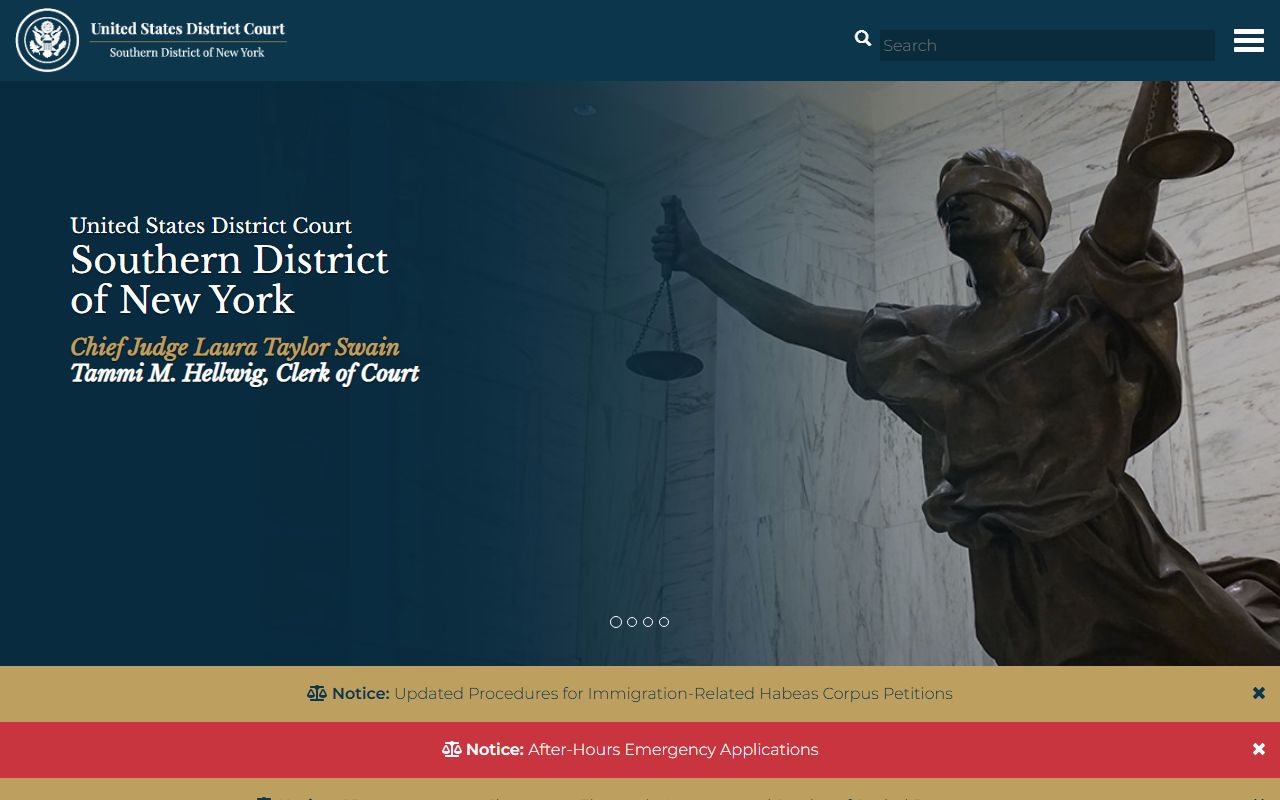
That page is the gateway to the federal docket and court divisions that take Westchester cases.
The White Plains federal courthouse has its own name and address.
The Charles L. Brieant Jr. United States Courthouse page lists the building at 300 Quarropas Street, White Plains, NY 10601.
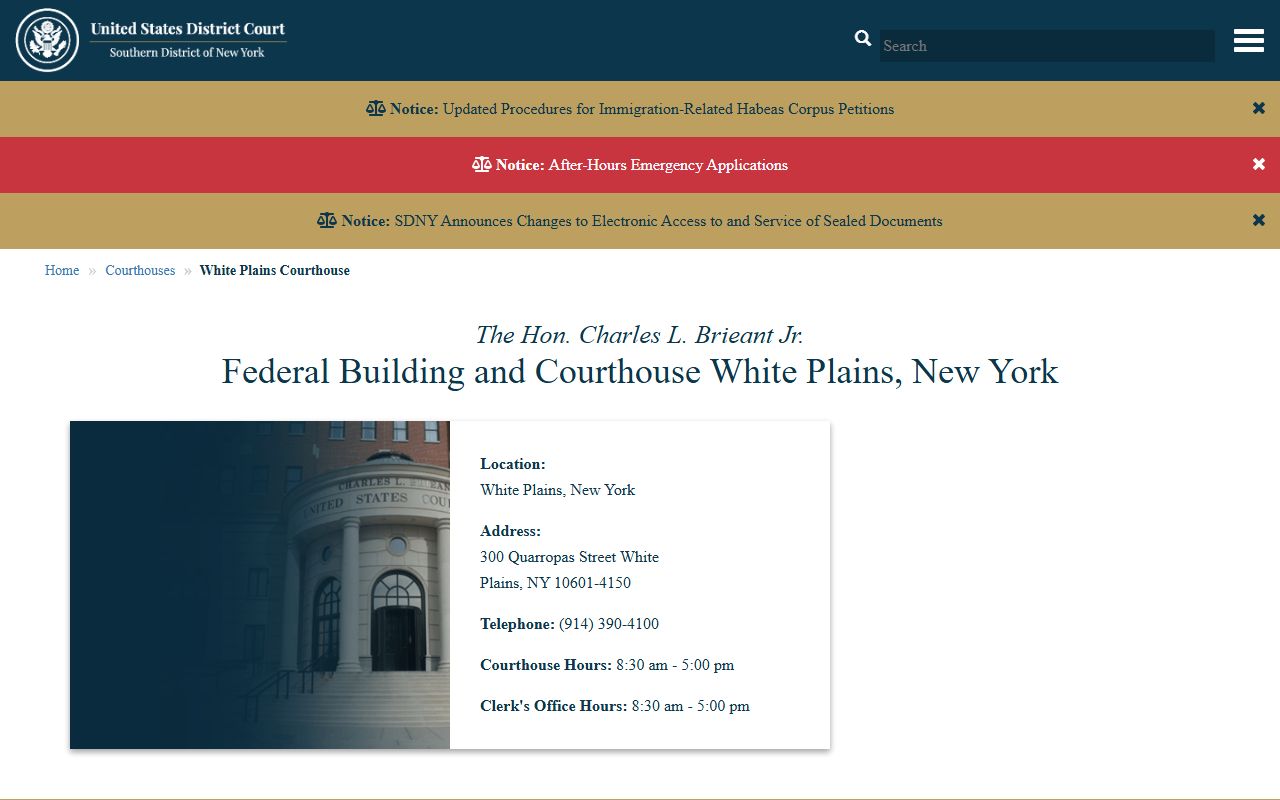
The courthouse sits near the county courthouse, a few blocks from Metro-North and one block east of the Galleria garage.
The U.S. Attorney runs a local office that prosecutes federal crimes in this region.
The U.S. Attorney's White Plains Division page covers federal cases out of Westchester, Rockland, Orange, Putnam, Dutchess, and Sullivan counties.
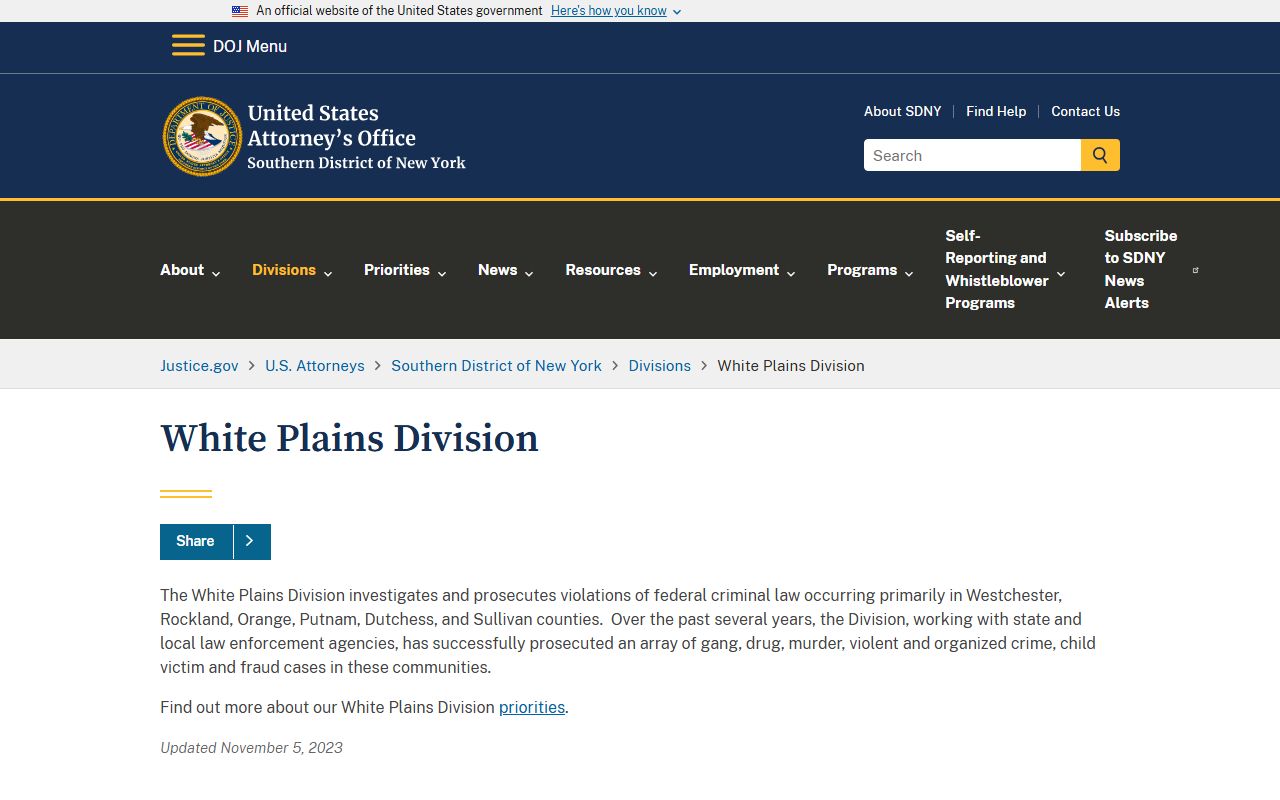
That office appears in federal criminal cases, civil enforcement, and federal appeals to the Second Circuit.
To pull federal dockets, use the national PACER system.
Sign in at PACER for federal civil, criminal, bankruptcy, and appellate dockets. Registration is required, and fees apply unless your usage stays low.
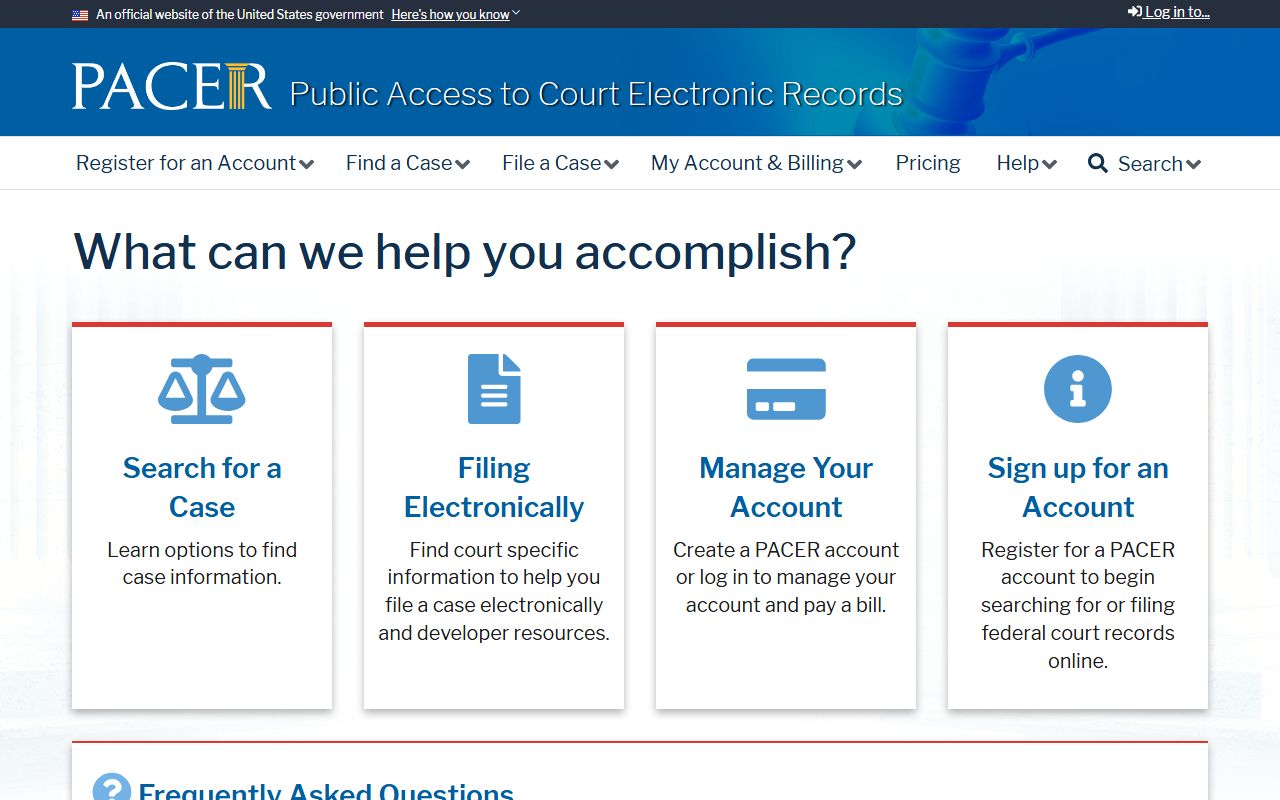
PACER reaches every federal court, so a Westchester SDNY case shows up there along with appeals.
For free opinions and docket material, a separate tool can help.
Search CourtListener for free opinions and RECAP docket records when they are available.
CourtListener can fill gaps when a document is posted there but locked behind a fee on PACER.
Searching Westchester County Supreme Court Records
No single site holds every record. The court type sets the tool. Supreme and County Court legal records, judgments, and liens sit with the County Clerk through Westchester Records Online. Civil Supreme Court cases statewide show up in WebCivil Supreme. Pending criminal cases with future dates appear in WebCriminal. E-filed papers run through NYSCEF, which lets the public search as a guest.
A few details speed any search. Have a party name, a case or index number, or a rough filing date ready. Criminal cases in the Clerk's online system carry the letters "DA" before the index or indictment number.
WebCivil Supreme covers New York State civil Supreme Court cases only. It offers several search paths, shown below.
| Search Path | What It Does |
|---|---|
| Index Search | Find a case by its index number. |
| Party Search | Find cases by a party name. |
| Attorney/Firm Search | Find cases by attorney or law firm. |
| Justice Search | Find cases by the assigned judge. |
| Court Calendars | See calendars by county, justice, and part. |
| eTrack | Track civil Supreme and local civil cases. |
Open WebCivil Supreme to use these paths. For Clerk records, dockets, and case lookup, see Westchester County court records and court dockets.
Access and Confidential Files
Court records are not handled like other government files. New York's Freedom of Information Law covers agency records. Court files are reached under the Judiciary Law instead. The County Clerk says legal records are open to the public unless a statute or court order seals them.
Some files stay closed. Matrimonial records, which include divorce, are sealed under state law. Only parties or their attorneys can see them, and the Clerk asks for proper photo ID first. Adoption files, juvenile records, and many sealed criminal cases are also off limits.
Note: Online records can lag behind the courthouse, so confirm any name, date, or outcome with the County Clerk or the court before you rely on it.