
What the Westchester County Surrogate's Court Covers
In New York, probate is not handled by a probate court with that name. The job belongs to the Surrogate's Court. Each county has one. The Westchester County Surrogate's Court sits in White Plains and handles the legal steps that follow a death, plus some matters that touch a person's estate while they live.
The court hears probate of wills, estate administration, and voluntary administration of small estates. It appoints fiduciaries, reviews accountings, and decides guardianship-related estate matters. When a will exists, the court confirms it is valid and names an executor. When there is no will, the court names an administrator to settle the estate. The Surrogate, Hon. Brandon R. Sall, presides over these cases. Eugene Yates serves as Chief Clerk.
Estate files stay separate from civil and criminal court files. That split matters for any search. A probate record will not show up in the County Clerk's legal index, and a money judgment will not appear in the estate system.
Probate Terms Defined
Estate files use words that trip up many people. A quick guide helps before you read a record or start a search. These terms come up again and again in Westchester County Surrogate's Court filings.
- Testator
- The person who made the will.
- Executor
- The person named in a will to carry it out.
- Administrator
- The person the court names to settle an estate when there is no will, a situation the law calls dying intestate.
- Guardianship
- A court arrangement that lets one person manage the property or care of someone who cannot do so alone.
- Fiduciary
- Any person the court trusts to act for an estate, such as an executor or administrator, who must act in good faith.
How to Search Westchester County Surrogate's Court Records
The main online tool is WebSurrogate. It is free. The system gives information on estate proceedings and other filings in New York Surrogate's Courts. Users can search files, pull documents, and view historical public records. Not every Surrogate's Court puts every record category online, so some Westchester files may still need a courthouse visit.
Open the WebSurrogate public search page to start. The lead-in screen lays out each search option and the access notice.
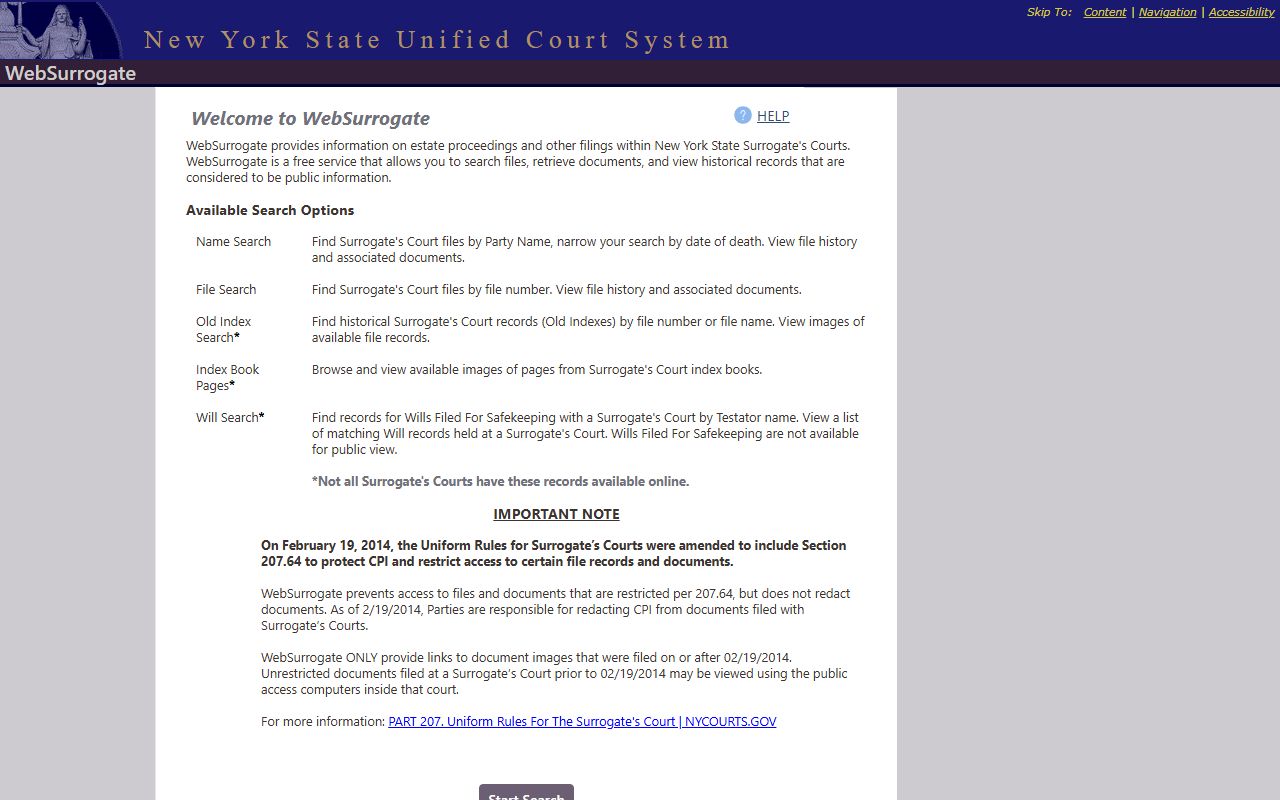
From that page you pick a search type, then enter a name, a file number, or browse the index books. The same screen carries the warning about protected personal information.
- Open WebSurrogate and choose the county and a search type.
- For a Name Search, enter the party name and narrow by date of death if you can.
- For a File Search, enter the file number.
- Review the proceeding details and any linked document images.
- For older files or restricted documents, visit the court and use the public access computers.
One detail trips up many searchers. WebSurrogate only links document images for papers filed on or after February 19, 2014. Older unrestricted documents can still be viewed, but only on the in-court computers.
WebSurrogate Search Options for Westchester Probate Records
WebSurrogate offers five ways in. Each one fits a different starting point. The table below sums up the options for a Westchester County Surrogate's Court search.
| Search Type | What You Enter | Notes / Format |
|---|---|---|
| Name Search | Party name | Narrow by date of death to cut the result list. |
| File Search | File number | Best when you already have the estate file number. |
| Old Index Search | File number or file name | Reaches historical records by older index entries. |
| Index Book Pages | Browse | View scanned index-book images page by page. |
| Will Search | Testator name | Wills filed for safekeeping are not open for public view. |
Note: WebSurrogate blocks restricted files but does not redact the documents it shows, so filers must remove confidential personal information themselves.
Westchester County Surrogate's Court Office and Contact
All probate work for the county runs through one office in the downtown White Plains courthouse. The Surrogate's Court sits on the 19th floor. Staff take filings, answer file questions, and process certified copies. Payments are accepted until 3:30 p.m., a bit before the office closes.
Westchester County Surrogate's Court
111 Dr. Martin Luther King Jr. Blvd., 19th Floor
White Plains, NY 10601
914-824-5656
Fax: 914-358-8042
Mon-Fri 9:00 a.m. to 5:00 p.m.; payments to 3:30 p.m.
People without a lawyer can get help from the Pro Se Help Center. Call 914-824-5701 or 914-824-5687 for guidance on forms and filing steps. The center cannot give legal advice, but it can point you to the right form. The Surrogate is Hon. Brandon R. Sall, and Eugene Yates is the Chief Clerk.
The official Westchester Surrogate's Court page lists the judge, clerk, hours, and links to forms, fees, and e-filing.
The Westchester County Probate Process
Probate follows a set path. The exact route depends on whether a will exists and how big the estate is. A small estate may move through voluntary administration, a shorter track. A larger estate with a will goes through full probate.
- Find out if the person left a will and whether the original still exists.
- Confirm the Surrogate's Court for the county where the person lived and held property.
- Choose the path: probate, administration, or voluntary administration.
- Prepare the petition, death certificate, the original will if any, heir details, and an estate value estimate.
- File the papers and pay the fees; use e-filing if it is required or offered.
- Serve citation or notice on the interested parties.
- The court reviews the will, the heirs, any objections, and the fiduciary.
- Letters Testamentary or Letters of Administration are issued.
- The fiduciary gathers assets, pays debts and taxes, and distributes the estate.
Some cases run long. A contested will, a missing heir, a real estate sale, or a tax problem can stretch the timeline well past the simple cases. The court files grow as each step is filed.
Westchester County Surrogate's Court Filing Fees
The Surrogate's Court charges fees by category. The amount usually scales with the size of the estate. The court also charges for certified copies and certain proceedings. Exact dollar amounts change over time, so the court's own fee page is the source to trust.
| Fee Category | What It Covers |
|---|---|
| Probate petition filing | Filing to admit a will and appoint an executor; scaled by estate value. |
| Administration petition filing | Filing to settle an estate with no will; scaled by estate value. |
| Voluntary administration | Filing for a small estate under the simplified track. |
| Certified copies | Letters, decrees, and other certified estate documents. |
| Accounting proceeding | Filing a fiduciary's accounting for court review. |
Check the current amounts on the official Surrogate's Court page, which links the state fee schedule and the Surrogate forms. Confirm the fee before you file so the office can accept your payment.
What Westchester County Surrogate's Court Records Show
An estate file holds the paper trail of a probate case. The petition opens it. After that come the will, if any, and the proof needed to admit it. The court then issues letters that name the fiduciary. As the estate is settled, the file fills with more papers.
A typical Westchester estate record can include the petition, the death certificate reference, the will, the citation served on heirs, the decree, and the letters. Later filings may add an inventory of assets, an accounting of what was paid out, and the final distribution. Each entry carries a file number and a date, much like the index number on a civil case.
Names of heirs, the decedent, and the fiduciary appear in the file. Asset values and debts can show as well. That is why the court protects some personal data and why filers must redact it first.
Restricted Westchester Surrogate's Court Records
Most estate files are open, but not every part is. Surrogate's Court Rule 207.64 protects confidential personal information in filings. WebSurrogate blocks restricted files from public view, yet it does not scrub data from the documents it does show. The duty to redact falls on the people who file.
Wills filed for safekeeping are a clear example of a closed record. A living person can leave a will with the court, but that document is not open to public view. Guardianship matters that involve minors or sensitive medical facts may also carry tighter limits.
Note: To see a restricted estate document, you may need to be an interested party or hold a court order, and older files often require a courthouse visit.